C299.jpg' alt='Windows Update Process Task Manager' title='Windows Update Process Task Manager' />Deploy Windows 1. System Center Configuration Manager Windows 1. Applies to. Windows 1. Windows 1. 0 Mobile. Looking for consumer information See Windows Update FAQImportant. Due to naming changes, older terms like CB,CBB and LTSB may still be displayed in some of our products. We are trying to automate Feature upgrade process from Windows 10 1607 to 1703. WSUS is used to distribute the update package. When upgrade is installed using gpo. Are you interested in getting Windows 10 Fall Creators Update Version 1709 Follow essential tips here to get a smooth Windows 10 update, meanwhile learn the Windows. EEventManager. exe file information EEventManager. Windows Task Manager. The process known as EEventManager Application or EEventManager MFC Application. In the following settings CB refers to Semi Annual Channel Targeted, while CBB refers to Semi Annual Channel. System Center Configuration Manager provides maximum control over quality and feature updates for Windows 1. Unlike other servicing tools, Configuration Manager has capabilities that extend beyond servicing, such as application deployment, antivirus management, software metering, and reporting, and provides a secondary deployment method for LTSB clients. Configuration Manager can effectively control bandwidth usage and content distribution through a combination of Branch. Cache and distribution points. Microsoft encourages organizations currently using Configuration Manager for Windows update management to continue doing so for Windows 1. The task manager in your customers Windows 7 operating system allows you to end and restart any unresponsive applications or processes. Configure Task Manager to display the full Path and CommandLine of running processes. The below posting is from Steve Pronovost, our lead engineer responsible for the GPU scheduler and memory manager. GPUs in the Task Manager Were excited. Library, learning resources, downloads, support, and community. Evaluate and find out how to install, deploy, and maintain Windows with Sysinternals utilities. Process_Name_Windows_8_Task_Manager.png' alt='Windows Update Process Task Manager' title='Windows Update Process Task Manager' />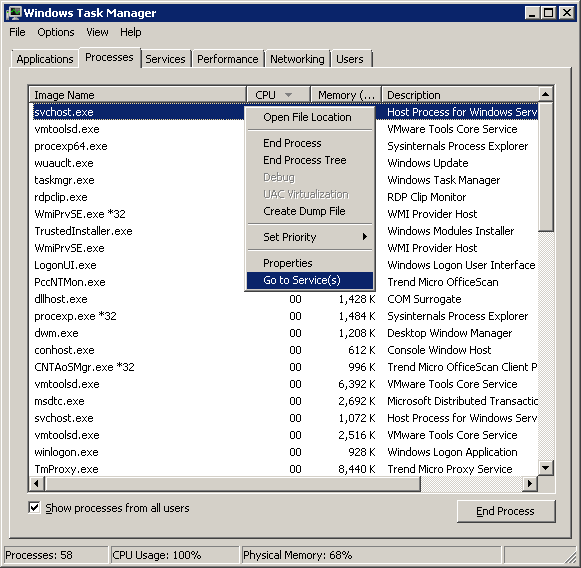 You can use Configuration Manager to service Windows 1. The first option is to use Windows 1. Servicing Plans to deploy Windows 1. Automatic Deployment Rule for software updates. The second option is to use a task sequence to deploy feature updates, along with anything else in the installation. Windows 1. 0 servicing dashboard. This articles explains features of Windows 7 Task Manager, the columns how to use it to monitor the applications, processes and services running on your computer. The Task Manager in Windows 10 v1709 now allows you to display the Command Line if you want to show the full path of a running process. Is This Process Safe Often, malware will try to mask itself in the Task Manager by imitating legitimate Windows system processes. Processes running under a user name. The Windows 1. 0 servicing dashboard gives you a quick reference view of your active servicing plans, compliance for servicing plan deployment, and other key information about Windows 1. For details about what each tile on the servicing dashboard represents, see Manage Windows as a service using System Center Configuration Manager. For the Windows 1. Heartbeat discovery. Enable heartbeat discovery for the site receiving Windows 1. Configuration for heartbeat discovery can be found in AdministrationOverviewHierarchy ConfigurationDiscovery Methods. Windows Server Update Service WSUS. System Center Configuration Manager must have the Software update point site system role added and configured to receive updates from a WSUS 4. KB3. 09. 51. 13 installed. Service connection point. Add the Service connection point site system role in Online, persistent connection mode. Upgrade classification. Select Upgrade from the list of synchronized software update classifications. To configure Upgrade classification. Go to AdministrationOverviewSite ConfigurationSites, and then select your site from the list. On the Ribbon, in the Settings section, click Configure Site Components, and then click Software Update Point. In the Software Update Point Component Properties dialog box, on the Classifications tab, click Upgrades. When you have met all these requirements and deployed a servicing plan to a collection, youll receive information on the Windows 1. Create collections for deployment rings. Regardless of the method by which you deploy Windows 1. Windows 1. 0 servicing process by creating collections of computers that represent your deployment rings. In this example, you create two collections Windows 1. All Current Branch for Business and Ring 4 Broad business users. Youll use the Windows 1. All Current Branch for Business collection for reporting and deployments that should go to all CBB clients. Youll use the Ring 4 Broad business users collection as a deployment ring for the first CBB users. To create collections for deployment rings. In the Configuration Manager console, go to Assets and ComplianceOverviewDevice Collections. On the Ribbon, in the Create group, click Create Device Collection. In the Create Device Collection Wizard, in the name box, type Windows 1. All Current Branch for Business. Click Browse to select the limiting collection, and then click All Systems. In Membership rules, click Add Rule, and then click Query Rule. Name the rule CBB Detection, and then click Edit Query Statement. On the Criteria tab, click the New icon. In the Criterion Properties dialog box, leave the type as Simple Value, and then click Select. In the Select Attribute dialog box, from the Attribute class list, select System Resource. From the Attribute list, select OSBranch, and then click OK. Note. Configuration Manager discovers clients servicing branch and stores that value in the OSBranch attribute, which you will use to create collections based on servicing branch. The values in this attribute can be 0 Current Branch, 1 Current Branch for Business, or 2 Long Term Servicing Branch. Leave Operator set to is equal to in the Value box, type 1. Click OK. Now that the OSBranch attribute is correct, verify the operating system version. On the Criteria tab, click the New icon again to add criteria. In the Criterion Properties dialog box, click Select. From the Attribute class list, select System Resource. From the Attribute list, select Operating System Name and Version, and then click OK. In the Value box, type Microsoft Windows NT Workstation 1. OK. In the Query Statement Properties dialog box, you see two values. Click OK, and then click OK again to continue to the Create Device Collection Wizard. Click Summary, and then click Next. Close the wizard. Important. Windows Insider PCs are discovered the same way as CB or CBB devices. If you have Windows Insider PCs that you use Configuration Manager to manage, then you should create a collection of those PCs and exclude them from this collection. You can create the membership for the Windows Insider collection either manually or by using a query where the operating system build doesnt equal any of the current CB or CBB build numbers. You would have to update each periodically to include new devices or new operating system builds. After you have updated the membership, this new collection will contain all managed clients on the CBB servicing branch. You will use this collection as a limiting collection for future CBB based collections and the Ring 4 Broad broad business users collection. Complete the following steps to create the Ring 4 Broad business users device collection, which youll use as a CBB deployment ring for servicing plans or task sequences. In the Configuration Manager console, go to Assets and ComplianceOverviewDevice Collections. On the Ribbon, in the Create group, click Create Device Collection. In the Create Device Collection Wizard, in the name box, type Ring 4 Broad business users. Click Browse to select the limiting collection, and then click Windows 1. All Current Branch for Business. In Membership rules, click Add Rule, and then click Direct Rule. In the Create Direct Membership Rule Wizard dialog box, click Next. In the Value field, type all or part of the name of a device to add, and then click Next. Select the computer that will be part of the Ring 4 Broad business users deployment ring, and then click Next. Click Next, and then click Close. In the Create Device Collection Wizard dialog box, click Summary. Click Next, and then click Close. Use Windows 1. 0 servicing plans to deploy Windows 1. There are two ways to deploy Windows 1. System Center Configuration Manager. The first is to use servicing plans, which provide an automated method to update devices consistently in their respective deployment rings, similar to Automatic Deployment Rules for software updates. To configure Windows feature updates for CBB clients in the Ring 4 Broad business users deployment ring using a servicing plan. In the Configuration Manager console, go to Software LibraryOverviewWindows 1. Servicing, and then click Servicing Plans. Viewing Windows 7 processes and applications. Solutions provider takeaway You can use the task manager to view Windows 7 applications and processes, and you can also end and restart them if theyre unresponsive. The task manager has six tabs in all, including the performance tab that displays usage graphs. By submitting your personal information, you agree that Tech. Target and its partners may contact you regarding relevant content, products and special offers. You also agree that your personal information may be transferred and processed in the United States, and that you have read and agree to the Terms of Use and the Privacy Policy. Task Manager. Task Manager, for many of us, is our go to tool for solving problems. You have a problem, you go to Task Managerits almost ingrained in us. Youll see immediate information about your processes, CPU usage, memory, network, and so forth. For one thing, the first time you start Task Manager, youll notice that you can now choose to see processes from all the users of the system. One thing youll notice right away is the Description aspect to the Processes tab and the Services tab see Figure 1. This was added in Vista. One of the new features of Task Manager is the ability to create a mini dump file of an application that is running. You can right click an application or process that is running and choose Create Dump File, which displays a dialog box that shows you where that file has been written. You can use this feature to discover why a particular application might be crashing so often. Or if a process has already crashed and is no longer responding, you can try to discover the cause. Figure 1. 1. 8 Task Manager showing the descriptions and options for Services. Task Manager has six tabs Applications. Processes. Services. Performance. Networking. Users. In addition to the tabs, there is a menu at the top that serves up even more options that well also cover in the following section. Lets start by looking at the Applications tab. Applications. This is the starting point for Windows Task Manager and there is more here than meets the eye. The Task column displays a list of open applications. This is a live look at your system. If you close one of the applications, it removes itself from this list. The Status column shows whether the application is Running or Not Responding. This simple layout allows you to quickly see what application is acting up. At the bottom are three buttons End Task Closes an application or process. Switch To Switches between applications or processes. Beginning Microsoft Word 2010 Pdf Download. New Task Starts an application from the dialog box that opens when you click this button. Below these buttons are real time information regarding Processes, CPU Usage, and the amount of used Physical Memory. At a glance, you can see what resource is affected by this view in the Task Manager. Using Task Manager to End an Application. The following steps show you how to use Task Manager to end an application. Press CtrlAltDel. Click Start Task Manager. In the Task area, locate an application that is running and click it. Click the End Task button. With this simple process, you see how easy it is to close an application. Of course, the purpose of Task Manager is to help you troubleshoot and cope with crashed applications, not ones that are working fine. So the next time an application hangs too long, follow the above steps again. When an application hangs too long, the Status column shows Not Responding. Clicking End Task should close the application. On rare occasion, an application might stubbornly stay open despite your attempts to end it. In this situation, press CtrlAltDel again and repeat the steps to close it. Using Task Manager to Start an Application. The following steps show you how to use Task Manager to start an application. In this example, you learn to end explorer. Task Manager. Press CtrlAltDel. Click Start Task Manager. Click the Processes tab. In the Image Name column, locate explorer. Click the End Process button. Windows Explorer closes but all other applications, including Task Manager, remain open. Click the Applications tab. Click the New Task button. The Create New Task dialog box opens. In the Open text box, type explorer. Click OK. Windows Explorer opens. The Create New Task button comes in handy in situations that call for you to reopen an application. If you know the path to the application, you can enter it otherwise, you can click the Browse button to navigate to the application name. One other option to mention on the Applications tab appears when you right click any application. You will find Create Dump File. Dump files capture data from the application that you can share with software developers and programmers who are trying to determine why an application crashes or has other faults. The dump file is saved locally and is a copy of what the application looks like in memory. You can send it to your help and support department, which can analyze its contents. Processes. This tab gives you a birds eye view of all your processes, including a button to Show Processes from all Users and the aforementioned End Process button. The Process tab is invaluable if your computer is running slow for an undetermined reason. By viewing the Image Name, CPU, Memory, and Description columns, you can focus on the precise area causing trouble. Using Task Manager to Monitor an Applications CPU and Memory Usage. The following steps show you how to monitor an applications CPU and memory usage. In this example, you monitor Windows Media Player. Press CtrlAltDel. Click Start Task Manager. Click the Processes tab. While still keeping the Task Manager in view on screen, open Windows Media Player. As the application opens, watch the CPU and Memory columns for the information it displays for Windows Media Player. You may need to resize the column to see the heading names. Close Windows Media Player. Open other applications and monitor their resource usage through the processes tab. By viewing your process resource usage, it becomes evident very quickly which process is causing the problem. If you are looking for a specific process and you have several open, click Image Name to sort the column. If a process is causing problem, it can be stopped by using the Processes tabas you learn in the following section. Using Task Manager to End a Process. This short exercise teaches you how to end a process through Task Manager. Use caution when doing this on applications not discussed in this exercise. Not ending a process safely can result in data loss or in rare cases, system instability. Press CtrlAltDel. Click Start Task Manager. Click the Processes tab. Look at the Description column and select a process that you know for example, select Windows Task Manager. Click the End Process button. You are asked to confirm this. Click End Process again. The process ends. A quick way to find a process associated with an application is to first locate the app on the Applications tab, right click it, and then choose Go To Process. This takes you to the Processes tab with the associated process highlighted. If more than one user is logged on to your machine when you run Task Manager and you are unable to see the process you are looking for, the Processes tab includes a Show Processes From All Users button that you can click to see any processes in use by other users logged on. You can also right click an application and choose Properties to access the properties of that particular executable.
Recent Pages
- An Evaluation Of Software Test Environment Architectures Des
- Blue Loading Screen Windows 10
- Adobe Acrobat 6 0 Ce Downloader
- Soal Test Cpns Sistem Cat Cpns
- Ontario Driver S License G2 Rules Engine
- The Secret Of Monkey Island Special Edition Walkthrough Pc
- Creator Of Animation Software Free Download
- Torrent Flight Of The Conchords Video
- Windows 7 Ultimate 64 Bit Spanish Download Library
- Does Not Have Token Serialization Permission To Treat
- Logo Design Studio Crack Keygen Pes
- How To Install Adobe Reader Linux Bind
- Telecharger Te Manquer De Grand Corps Malade Je